
KYON PGR – Patellar Groove Replacement
The PGR device is a unique solution to address the condition of patellar luxation where the kneecap dislocates from its normal location in the patellar groove. It is the first and only device on the market to restore a functional patellar groove.
Patello-femoral degenerative joint disease is a frequent, often ignored consequence of some of the most common conditions of the canine stifle such as patellar luxation or cruciate ligament degeneration and rupture. Surgical treatments of patellar luxation, whether by tibial tuberosity transposition or by corrective osteotomies of the femur and/or tibia combined with patellar groove deepening by one of several methods, seek restoration of joint stability.
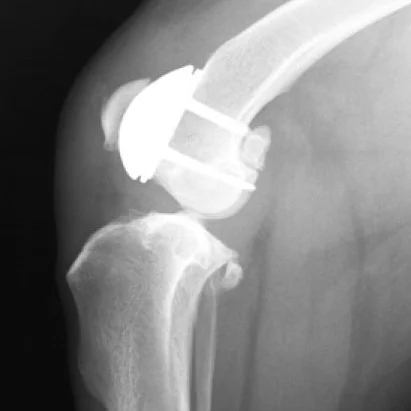
The PGR implant provides:
Immediate stability of patella in a smooth artificial groove to prevent luxation
Easy and secure fixation by a two component design consisting of a base plate and an artificial groove
Low friction ensured by a smooth Amorphous Diamond-Like Carbon (ADLC) coated groove surface with very low coefficient of friction (m=0.05 on steel), offering the possibility of maintaining heat generation below the threshold of thermal necrosis.
Rapid bone ingrowth of the baseplate facilitated by BioCer® surface treatment
More than 10 different sizes to ensure ideal fit for every dog breed
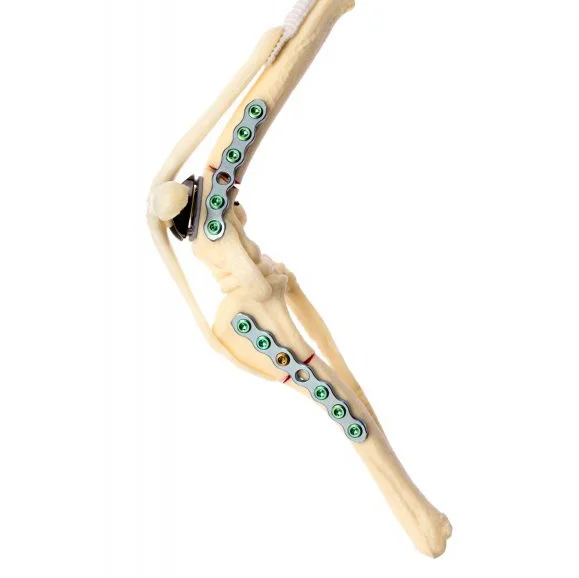
Principles
Ostectomy of the patellar groove just cranially to the insertion of the tendon of the long digital extensor creates a broad, well perfused cancellous bone bed onto which the base plate is secured by titanium bone screws. The groove component is then attached to the base plate by means of three conical pegs fitted into receiving conical holes. The broad area of the ostectomy of the patellar groove allows for considerable freedom in medial-lateral positioning of the base plate that can be used to improve quadriceps-to-patellar tendon alignment, thus avoiding conventional tibial tuberosity transposition. Use of trial implants during surgery aids the search for an optimal position of the final implant.
Functional loading of the implant leads to compression of its interface to the bone, which is mechanically favorable to the ill-conditioned load transfer called for by conventional tuberosity transposition, where the full force of the patellar tendon is transferred to the tibia by pins and a figure eight wire.
Significant angular deformities can be treated by concurrent corrective osteotomies in addition to patellar groove replacement should the condition of the patello-femoral joint call for it. The same is true for cruciate ligament ruptures that can be concurrently treated by, for example, Tibial Tuberosity Advancement (TTA).
